Tetrads
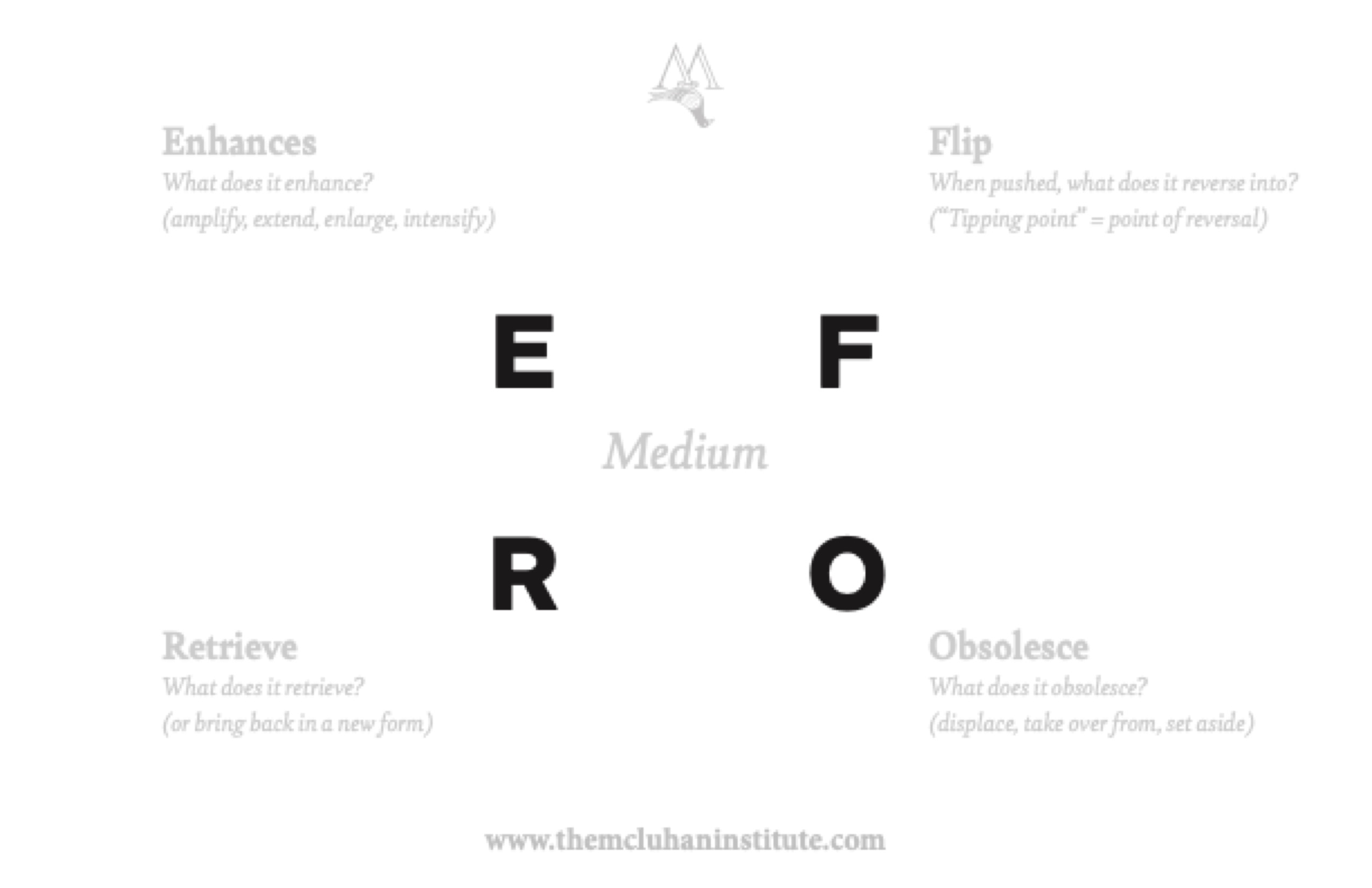
The Laws of Media, or Tetrad of Media Effects, is a framework developed by Marshall McLuhan and his son Eric McLuhan. Tetrads are a way of understanding, diagnosing, and predicting the effects of technology and media on society, culture, and human experience.
Four laws, in the form of questions, can be applied to any medium:
Enhance
What does it amplify?
Flip
What does it reverse into?
Retrieve
What does it bring back?
Obsolesce
What does it make obsolete?
Click any medium below to explore its effects with the Four Laws of Media. You can chat with Claude or ChatGPT.
ai video
AI Video is synthetic moving image generated by machine learning models from text or image prompts. It emerged as a technology of imagination made visible, enabling anyone to produce cinematic content without cameras, actors, or traditional production—democratizing and destabilizing visual storytelling.


booze
Booze is the fermented or distilled consumption of alcohol. It emerged alongside civilization itself as a technology of social lubrication, ritual, and altered consciousness—loosening inhibition, binding communities through shared drinking, and blurring the boundary between the sacred and the profane.
camera
Camera is the optical capture and preservation of a moment in time. It emerged in the 19th century as a technology of mechanical reproduction, freezing reality into portable images—democratizing portraiture, transforming memory into evidence, and making the visible world infinitely repeatable.
claude code
Claude Code is the agentic coding tool that lives in your terminal and understands your codebase. It emerged as a technology of programmer augmentation, enabling developers to command software through natural language—collapsing the distance between intention and implementation, and extending the capacity to build to those who could not previously write code.
clock
Clock is the mechanical measurement and display of time. It emerged in medieval monasteries as a technology of coordination, abstracting the rhythms of nature into uniform, countable units—enabling synchronized labor, scheduled transport, and the commodification of hours.
house
House is the physical structure of domestic dwelling. It emerged as humanity's primary shelter technology, evolving from caves and huts to the modern home—creating private space, family territory, and the foundation of property ownership and social stability.
Instagram is the image-sharing platform centered on visual self-presentation. It emerged as a technology of curated identity, enabling users to construct and broadcast idealized versions of their lives—transforming everyday moments into aesthetic performances for social validation.
money
Money is the medium of exchange and store of value. It emerged as a technology to transcend barter, enabling abstract trade across time and space—transforming labor into portable wealth and creating the basis for complex economies and social stratification.
openclaw
OpenClaw (formerly Moltbot, originally Clawdbot) is an open-source autonomous AI agent that runs locally on your computer, controlling files, browsers, emails, and applications on your behalf. It emerged as a technology of radical delegation—extending human agency by granting AI direct access to the operating system, collapsing the gap between intention and execution, and retrieving the ancient dream of the tireless assistant while obsolescing the need for manual digital labor.
printed-word
Printed Word is the mechanical reproduction of text through movable type. It emerged in the 15th century as a mass communication technology, democratizing knowledge, standardizing languages, and enabling the spread of ideas beyond oral tradition and manuscript copying.
purse
Purse is the portable container for personal valuables and money. It emerged as a technology of mobile wealth, enabling individuals to carry economic power on their person—extending identity, status, and purchasing capability beyond the home.
radio
Radio is the wireless transmission and reception of audio signals through electromagnetic waves. It emerged in the early 20th century as a broadcast medium, bringing news, music, drama, and conversation directly into homes—requiring no literacy, no travel,
and no visual attention.
refrigerator
Refrigerator is the mechanical preservation of food through controlled cooling. It emerged in the early 20th century as a domestic technology, extending food freshness, eliminating daily shopping, and transforming kitchen design and eating patterns.
slang
Slang is the informal vocabulary created by subcultures and communities. It emerged as a technology of in-group identity, enabling social bonding through shared language—marking belonging, resisting authority, and constantly evolving to maintain its exclusivity.
television
Television is the electronic transmission of moving images and sound into the home. It emerged in the mid-20th century as a domestic broadcast medium, collapsing distance between event and audience—making the living room a window onto wars, elections, sitcoms, and spectacle.
Twitter/X is the microblogging platform built on short-form public posts. It emerged as a technology of instant broadcast, enabling anyone to publish thoughts to the world in real-time—collapsing the distance between event and commentary, between public figure and audience.
zipper
Zipper is the interlocking-tooth fastener for joining two edges of fabric. It emerged in the early 20th century as a technology of speed and convenience, replacing buttons, laces, and hooks—accelerating the act of dressing and undressing, and reshaping garment design around the expectation of effortless closure.